PPC vs SEO: Which Digital Marketing Strategy Should Your Business Invest in First?
Ask ten different digital marketing agencies whether you should invest in SEO or PPC first, and you’ll likely get the answer that matches whatever service they’re most invested in selling you.
The reality is more nuanced — and genuinely depends on your business situation, your goals, your competitive landscape, and your timeline. Both SEO and PPC are powerful, both have distinct strengths, and for many businesses, the right answer is an integrated strategy that uses each channel where it performs best.
But if you have limited budget and need to prioritise, this guide gives you the honest framework to make the right decision — one that’s based on what actually works, not what’s most profitable to sell you.
What You’re Actually Choosing Between
Before comparing, define clearly what each channel does.
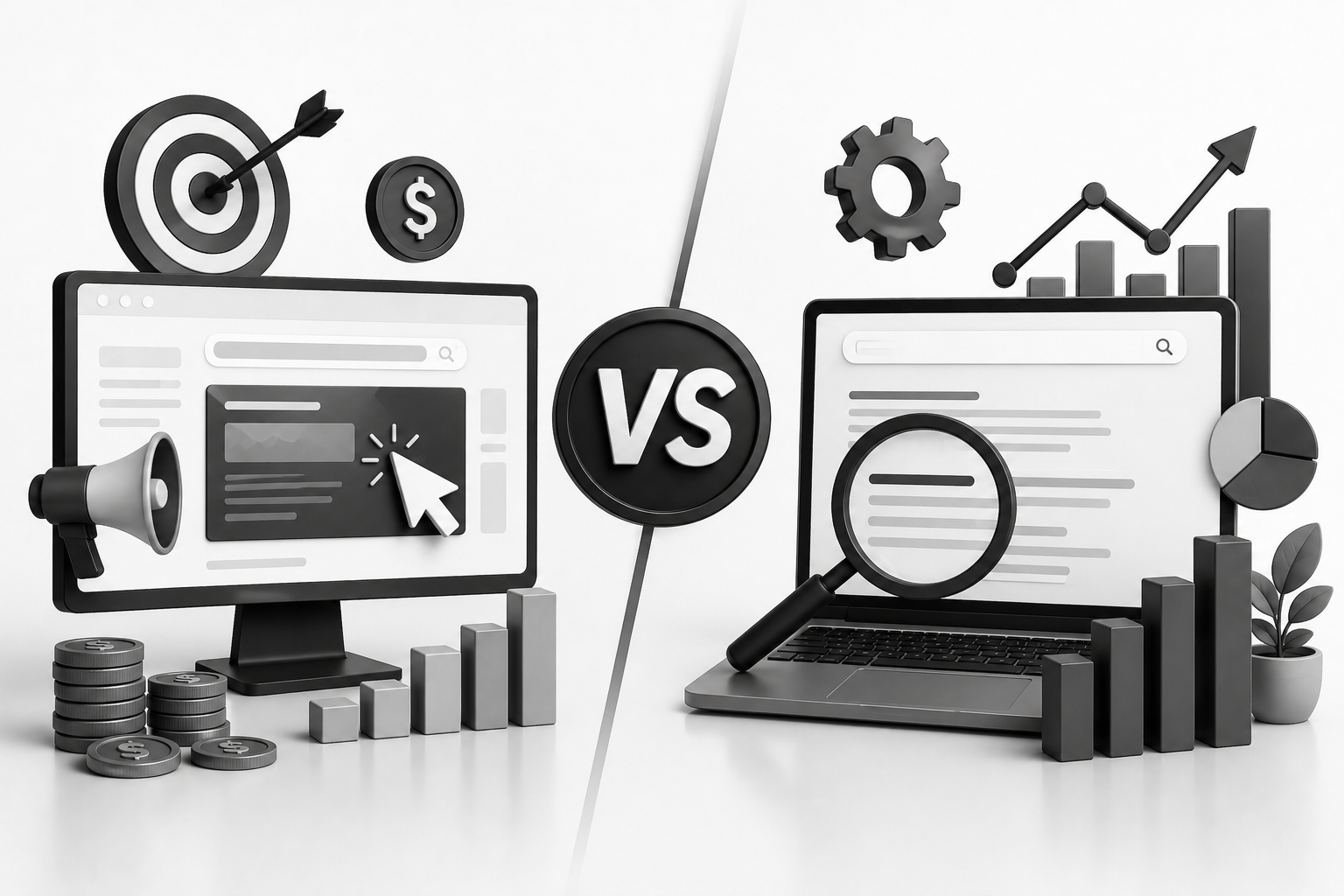
PPC (Pay-Per-Click advertising) — primarily Google Ads — places your business at the top of search results for specific keywords, immediately, in exchange for a cost-per-click. You pay every time someone clicks your ad. Stop paying, and your visibility disappears instantly.
SEO (Search Engine Optimisation) — improves your organic (non-paid) rankings in search results through technical improvements, content quality, and authority building. Results take months to develop but continue delivering traffic without ongoing per-click costs once rankings are established.
Both target people who are actively searching for what you offer. The difference is timing, cost structure, and sustainability.
The Case for Starting with PPC
PPC makes sense as a starting point in specific scenarios:
You need leads now. A business that has just launched, or a business entering a new market, often can’t afford to wait 4 to 6 months for SEO to generate traffic. PPC delivers targeted visitors from day one.
You’re testing a new product or offer. PPC data is enormously valuable for understanding which messages resonate, which keywords convert, and what your actual cost per acquisition is before committing to a long-term organic strategy around those keywords.
Your market has strong, immediate search demand. If customers are actively searching for your product or service category right now, paid search captures that intent immediately while organic rankings build.
You have a high customer lifetime value. If each new customer is worth ₹50,000 or more to your business, a cost-per-lead of ₹2,000–₹5,000 from paid search may be very comfortable — making PPC a straightforward positive ROI investment from launch.
The risk with PPC is dependency. Businesses that invest exclusively in paid advertising build no lasting asset. If costs rise — and in competitive markets, cost-per-click tends to increase over time — your lead generation cost increases with them.
The Case for Starting with SEO
SEO makes sense as a foundational strategy in these situations:
You have a 6 to 12 month runway. If you have the time to let SEO compound, the long-term economics are significantly better than paid advertising. A first-page organic ranking delivers traffic every day without a per-click cost.
Your industry has high cost-per-click rates. In competitive industries — legal services, finance, healthcare, real estate — Google Ads cost-per-click can be ₹200–₹1,000 or more per click. At those rates, SEO often delivers a lower cost per lead over 12 months, even accounting for the time required to rank.
Content is central to your value proposition. Businesses where demonstrating expertise builds trust — consultancies, professional services, technology companies, education providers — benefit enormously from content-led SEO that both ranks and demonstrates credibility to potential clients reading before they contact you.
You’re building a brand, not just generating leads. Organic search visibility builds brand recognition and authority in a way that paid ads don’t. Consistently appearing in the top organic results for your industry’s key terms signals credibility that paid placements can’t replicate.
The Integrated Approach: Why Most Businesses Need Both
For businesses with sufficient budget, the most effective digital marketing strategy uses PPC and SEO together — each doing what it does best.
PPC fills the immediate pipeline while SEO builds. Paid campaigns generate leads from month one, preventing the revenue gap that a pure SEO strategy creates during the 3 to 6 month build phase.
SEO data improves PPC targeting. As organic rankings reveal which content earns high engagement and which keywords bring qualified visitors, PPC campaigns can be refined to target the highest-converting terms more precisely.
PPC data accelerates SEO strategy. Conversion data from paid campaigns shows which keywords and messages actually produce customers — not just traffic. This informs content creation and ensures SEO investment goes toward terms with proven commercial value.
Together, they dominate the search results page. A business appearing in both paid and organic results for the same high-intent keyword gets substantially more total search real estate — and the credibility signal of appearing in both positions simultaneously is meaningful to potential customers.
How to Decide: A Practical Decision Framework
Answer these questions honestly:
- How quickly do I need leads? If immediately — start with PPC. If within 6 months — SEO is viable from the start.
- What is my customer lifetime value? High LTV justifies higher PPC cost-per-acquisition. Low LTV requires lower acquisition costs that SEO can eventually deliver.
- How competitive is PPC in my industry? Check Google Keyword Planner for indicative cost-per-click rates. Very high CPC markets often make SEO more cost-efficient long term.
- Can I produce quality content consistently? SEO without content is incomplete. If you can’t commit to regular content production, PPC may be more effective until that capacity is in place.
- What is my budget? If the budget is tight, local SEO is often the highest-ROI starting point for small businesses, with PPC added as budget grows.
CraftArchitech’s Approach to Integrated Digital Marketing
CraftArchitech’s digital marketing services are designed to work together — SEO and paid performance marketing planned in coordination from the outset, with strategy built around your specific business timeline and revenue goals.
For businesses that need a strong technical foundation before either channel can perform effectively, the team’s web development services and Shopify development ensure your website converts the traffic that both SEO and PPC send to it — making every marketing rupee work harder.
The starting point is always the same: a conversation about your business, your goals, and your timeline — before any recommendation is made about which channels to prioritise and in what order.
Frequently Asked Questions
Q1: Is SEO or PPC better for a new business in India?
For most new businesses, a combination is most effective — PPC to generate leads immediately while SEO builds over the medium term. If budget only allows one, local SEO for a geographically focused business or targeted PPC for a business with clear high-intent keywords are both strong starting points depending on timeline.
Q2: How much should I budget for PPC advertising in India?
A meaningful test of Google Ads requires sufficient budget to generate statistically significant data — typically a minimum of ₹15,000–₹30,000 per month in ad spend, in addition to management fees. Lower budgets produce insufficient data for proper optimisation.
Q3: Can I run PPC and SEO simultaneously with a small team?
Yes, though each requires dedicated attention. Many small businesses manage this through an agency that handles both channels with an integrated strategy, ensuring the channels inform each other rather than running in parallel without connection.
Q4: Does a high Google Ads budget affect my organic rankings?
No. Google’s organic search algorithm is completely separate from its advertising platform. Spending on Google Ads does not improve or damage your organic search rankings in any way.
Q5: What is a realistic cost per lead from digital marketing in India?
Cost per lead varies enormously by industry and channel. Local service businesses using local SEO and Google Ads often achieve cost per lead of ₹200–₹800. Competitive B2B industries with complex sales cycles may see ₹2,000–₹10,000 or more. Setting cost per lead targets upfront, based on your customer lifetime value, is essential before investing in any channel.
Get a Clear Digital Marketing Strategy Built Around Your Business
You don’t need to choose between SEO and PPC blindly. You need a strategic partner who will assess your situation honestly and recommend what will actually generate the best return for your specific business — not what generates the best margin for the agency.
Book a free strategy session with CraftArchitech — and get a clear, evidence-based recommendation on exactly where your digital marketing investment should go first.