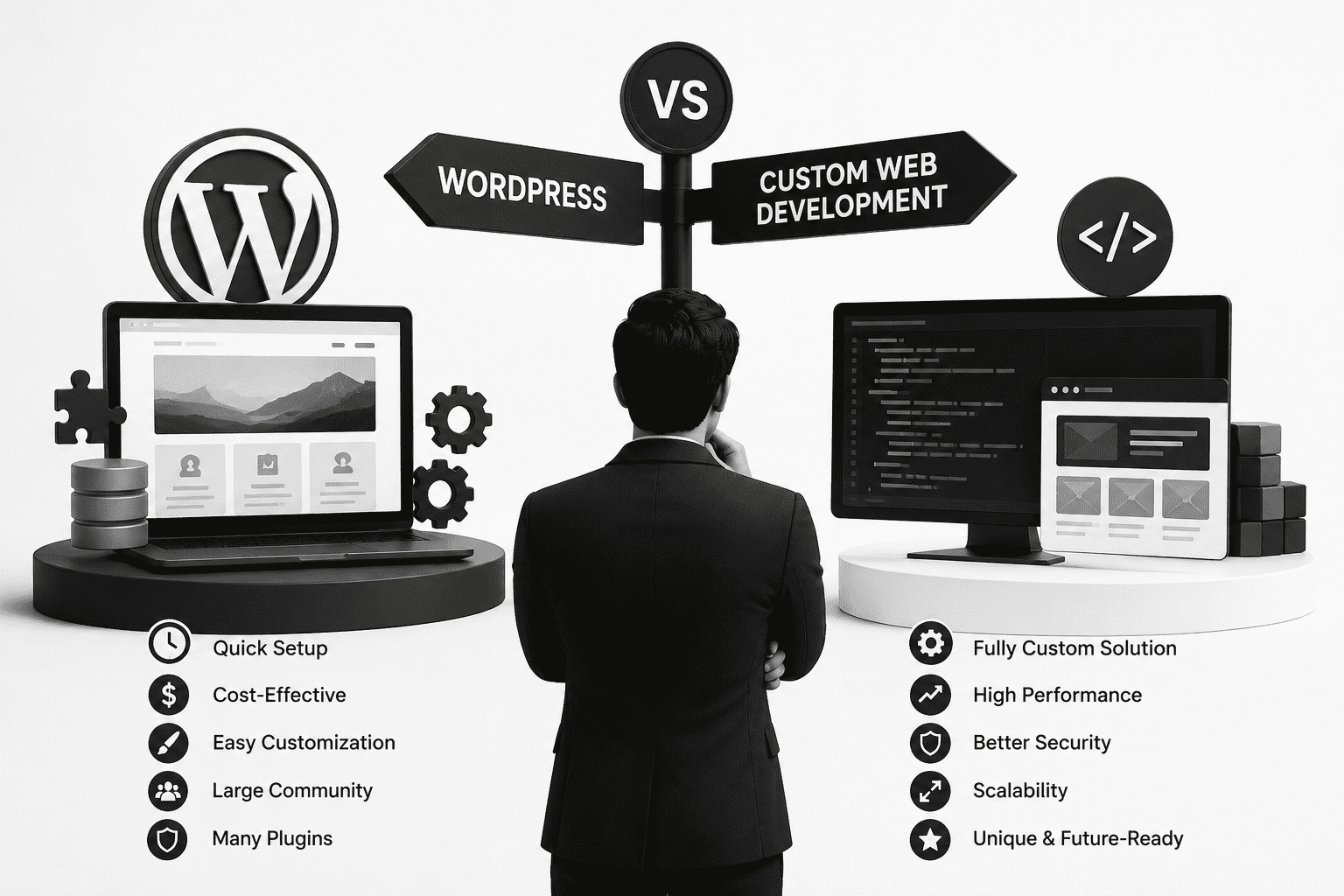
WordPress vs Custom Web Development: Which One Is Right for Your Business in 2026?
It’s one of the most common questions businesses face when they’re ready to invest seriously in their digital presence: should we build on WordPress, or go fully custom?
The wrong answer — made without proper understanding — costs businesses significant time and money. A company that builds a fully custom solution when WordPress would have served them perfectly overspends on development and ends up with a system that’s harder to manage. A company that forces a complex business requirement into WordPress when it needs a purpose-built architecture ends up with an unstable, patched-together solution that causes problems for years.
The right answer depends entirely on your business — its complexity, its growth trajectory, its content needs, and what the website actually needs to do. This guide gives you the framework to make that decision confidently.
What WordPress Development Actually Means in 2026
WordPress powers approximately 43% of all websites on the internet. But the version of WordPress used by a solo blogger posting weekly articles is a fundamentally different implementation from the enterprise-grade, custom-built WordPress powering major media companies, SaaS platforms, and complex B2B service websites.
When a professional WordPress development company builds your website, they’re not installing a theme and handing it over. They’re building a custom theme or block-based template tailored to your brand, developing custom post types and taxonomies for your content structure, building or integrating the specific functionality your business needs, and optimising the entire codebase for performance, security, and scalability.
The result is a website that runs on WordPress infrastructure — giving you the benefits of the world’s most mature CMS — but is custom-built for your specific requirements.
When WordPress Is the Right Choice
WordPress is the right foundation for the majority of business websites, and here’s why:
Content-driven businesses. If your website needs a blog, a resource library, a knowledge base, or any form of regularly updated content — WordPress is unmatched. Its content management interface is intuitive, well-documented, and familiar to almost every content team. Adding pages, updating service descriptions, publishing articles, and managing media are all tasks that non-technical staff can handle confidently.
Service businesses and professional websites. Consultancies, agencies, clinics, law firms, accounting practices, and professional service providers of all kinds benefit from WordPress’s flexibility combined with its ease of management. You can have a genuinely sophisticated website that your team controls without needing a developer for every update.
SEO-focused websites. WordPress’s architecture is inherently SEO-friendly, and the ecosystem of SEO tools built for it is unrivalled. For businesses with serious content marketing and organic search ambitions, WordPress provides the infrastructure to build and manage a large, well-structured site at scale.
Businesses with defined but not extreme customisation needs. If your requirements are complex — custom calculators, membership areas, booking systems, directory functionality — but fall within what WordPress plugins and custom development can address, WordPress is almost always the more cost-effective and maintainable solution.
When Custom Development Makes More Sense
There are genuine scenarios where WordPress is the wrong tool:
Complex, proprietary business logic. If your website needs to implement processes, calculations, or workflows that are unique to your business model and don’t map to any existing CMS architecture, a purpose-built application may be more appropriate than forcing bespoke logic into a WordPress structure.
Platform-scale applications. If you’re building a marketplace, a SaaS product, a platform with thousands of simultaneous users, or a system with complex real-time functionality, a custom-built application with a framework designed for that scale is generally more appropriate than WordPress.
Extreme performance requirements. Certain use cases — high-frequency data processing, millisecond-response APIs, complex real-time interactions — are better served by custom-built architectures optimised for those specific demands.
Highly unique UX requirements. If the user interface your product requires is fundamentally unlike anything a CMS would support — a deeply interactive web application, a data visualisation tool, a browser-based software product — custom development is the right foundation.
The Hybrid Approach: Headless WordPress
An increasingly popular middle ground is headless WordPress — where WordPress functions as the content management backend while the front end is built with a modern JavaScript framework like Next.js or Gatsby.
This approach gives businesses the familiar WordPress content management experience their teams are comfortable with, while delivering the performance, flexibility, and interactivity of a custom-built front end.
For businesses that need both sophisticated content management and a cutting-edge user experience, headless WordPress can be the best of both worlds — though it requires a development team experienced in both WordPress and modern front-end frameworks.
CraftArchitech’s WordPress development services include both traditional and headless WordPress implementations, scoped based on what your specific business requirements genuinely need.
Questions to Help You Decide
Ask yourself honestly:
- Will non-technical staff need to update the website regularly? (WordPress)
- Is content creation and SEO a core part of your marketing strategy? (WordPress)
- Does your website need to function like a software application with complex user interactions? (Consider custom)
- Are your requirements complex but within the range of what plugins and custom WordPress development can address? (WordPress)
- Do you need a platform that scales to millions of users with real-time data processing? (Consider custom)
- Is your priority speed to market and manageable ongoing maintenance costs? (WordPress)
Most businesses, when they answer these questions honestly, find that a well-built WordPress site covers everything they need — and more.
What CraftArchitech Delivers as a WordPress Development Company
CraftArchitech has built WordPress websites for service businesses, ecommerce brands, professional practices, startups, and established enterprises. Every project begins with a genuine discovery process that maps your business requirements to the right architecture — not a templated approach that forces your needs into a predetermined solution.
Deliverables include custom theme development, performance optimisation, SEO-ready site architecture, custom plugin development, third-party API integrations, and comprehensive training so your team can manage the site confidently after launch.
For businesses that need to hire a dedicated WordPress developer rather than a full project engagement, CraftArchitech also offers hire WordPress developer services — giving you direct access to experienced WordPress talent for ongoing development work.
Frequently Asked Questions
Q1: Is WordPress secure enough for a business website?
Yes, when properly maintained. WordPress core is actively maintained by a global development community. Security issues on WordPress websites almost always stem from outdated plugins, weak passwords, or poor hosting — all of which are addressed in a properly managed deployment. CraftArchitech’s maintenance services include ongoing security monitoring and updates.
Q2: Can WordPress handle large ecommerce stores?
WordPress with WooCommerce handles ecommerce at significant scale. For very large product catalogs or complex ecommerce requirements, the architecture needs to be carefully designed and hosted appropriately. For most growing ecommerce businesses, WordPress/WooCommerce or Shopify (handled by CraftArchitech’s Shopify development team) are both excellent options.
Q3: How much does WordPress development cost compared to custom development?
Professional WordPress development is typically significantly more cost-effective than fully custom development for equivalent functionality. The cost advantage comes from the existing plugin ecosystem and the mature WordPress architecture, which means developers aren’t building from scratch. Custom development costs more upfront because every element must be built without a foundation.
Q4: How long does a professional WordPress website take to build?
A well-scoped WordPress website for a service business or SME typically takes 4 to 8 weeks. Larger, more complex sites with custom functionality and content migration take longer. Timeline accuracy depends on a clear scope and responsive client input during the process.
Q5: Can I migrate an existing website to WordPress?
Yes. Content migration from other platforms — including custom-built sites, Wix, Squarespace, Joomla, and others — to WordPress is a standard service. A professional migration preserves existing URL structures, content, and SEO signals while rebuilding on a stronger, more manageable foundation.
Make the Right Development Decision for Your Business
Choosing the wrong platform costs businesses months of rework and thousands in avoidable expense. Choosing the right one, built properly, creates a digital foundation that supports everything your business does online.
Talk to CraftArchitech’s WordPress development team for an honest, experienced recommendation based on your specific requirements — not a sales pitch for whichever service is most profitable to sell.